Random Numbers Generator 1 100
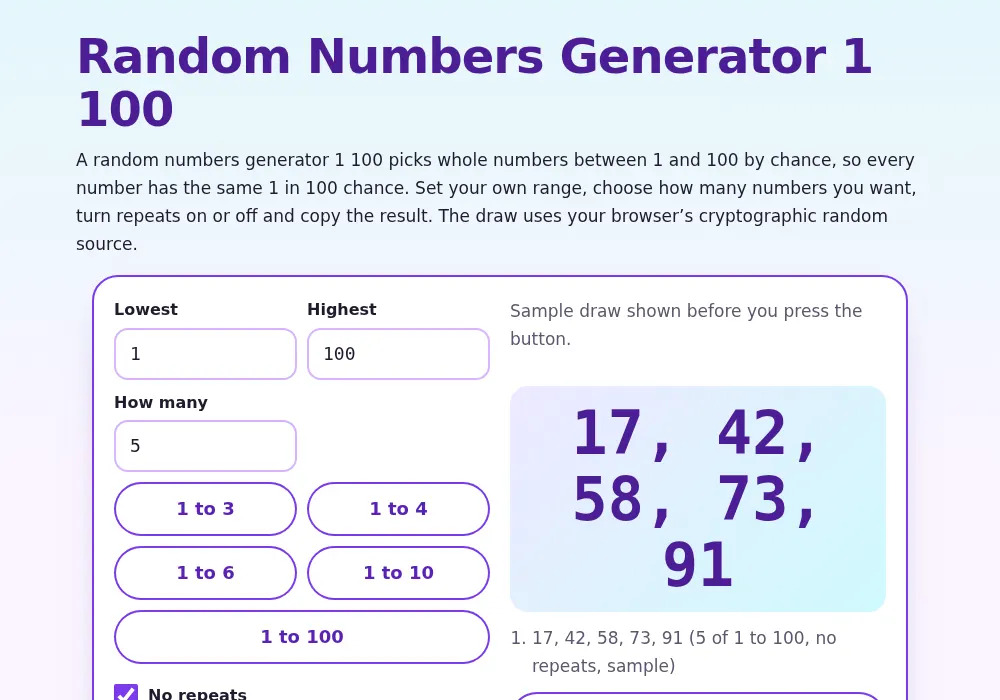
A random numbers generator 1 100 picks whole numbers between 1 and 100 by chance, so every number has the same 1 in 100 chance. Set your own range, choose how many numbers you want, turn repeats on or off and copy the result. The draw uses your browser’s cryptographic random source.
Sample draw shown before you press the button.
- 17, 42, 58, 73, 91 (5 of 1 to 100, no repeats, sample)
Mixed number calculator
Dicekite Team · Updated
Pick whole numbers from 1 to 100, or any range, with repeats on or off. Running a football squares pool? The squares tool shuffles 0–9 for both axes. More generators are on DiceKite.
Pick numbers from 1 to 100
Set the lowest and highest number, choose how many you need and decide whether a number may come up twice. With repeats off the tool works like drawing tickets from a hat, so every number appears at most once. Sort the result if you want it in order, then copy it in one tap.
Each number comes from crypto.getRandomValues, the browser’s cryptographic random source. To turn 32 random bits into a number from 1 to 100 without favoring small values, the tool throws away the few values that would make the split uneven (rejection sampling), so every number has exactly the same chance. With No repeats on, it shuffles the whole range and deals from the top, so no number can appear twice. Nothing you type is sent to a server or stored.
- Classroom picks: draw a student number or a page to read.
- Games: choose who goes first or draw a hidden number to guess.
- Raffles among friends: number the entries and draw one number; see the limits below.
- Testing and samples: pick numbers for a quick spot check.
Is every number equally likely?
Yes: each number from 1 to 100 has exactly a one in a hundred chance on every single draw, because the tool uses your browser’s cryptographic random source. People still remember streaks and favourite numbers such as 7 or 37, which is why human picks are not random even when the tool is.
| Range | Chance of each number per draw | Repeats |
|---|---|---|
| 1–100 | 1 in 100 (1.00%) | Optional |
| 1–3 | 1 in 3 (33.33%) | Optional |
| 1–4 | 1 in 4 (25.00%) | Optional |
| 1–6 | 1 in 6 (16.67%) | Optional |
| 1–10 | 1 in 10 (10.00%) | Optional |
Ask for 5 numbers from 1 to 100 with No repeats. There are 100 × 99 × 98 × 97 × 96 ÷ 120 = 75,287,520 different sets of five, and each set is equally likely. A single draw gives any one number a 1 in 100 chance, which is 1 percent. If repeats are allowed and you draw five times, the chance that a particular number shows up at least once is 1 − 0.995, about 4.90 percent. The numbers shown before you press the button are only an example draw.

This page is for everyday picks and games. It is not a certified source for official lotteries, gambling or any draw where a regulator requires audited randomness.
Small ranges: 1–3, 1–4 and 1–10
Tap a preset to switch range instantly. One to three settles a three-way choice, one to four picks a quarter or a team, one to six replaces a die and one to ten works for quick classroom games. Each preset keeps your no-repeat setting, so you can draw the whole range in shuffled order.
The quick buttons set common ranges. A random number from 1 to 3 gives each of 1, 2 and 3 a chance of 1 in 3, about 33.3 percent. From 1 to 4 each number has 1 in 4, or 25 percent, and from 1 to 6 it behaves like a die, with 1 in 6 for each face. Type any lowest and highest value, including negative numbers, to build your own range.
Which number generator is most reliable?
For everyday picks any generator built on a cryptographic random source is reliable enough, including this one. Draws that decide money or prizes need an audited service and a public record, which a browser tool cannot give. That is why the tool states its source and what it is not for.
Mixed number calculator
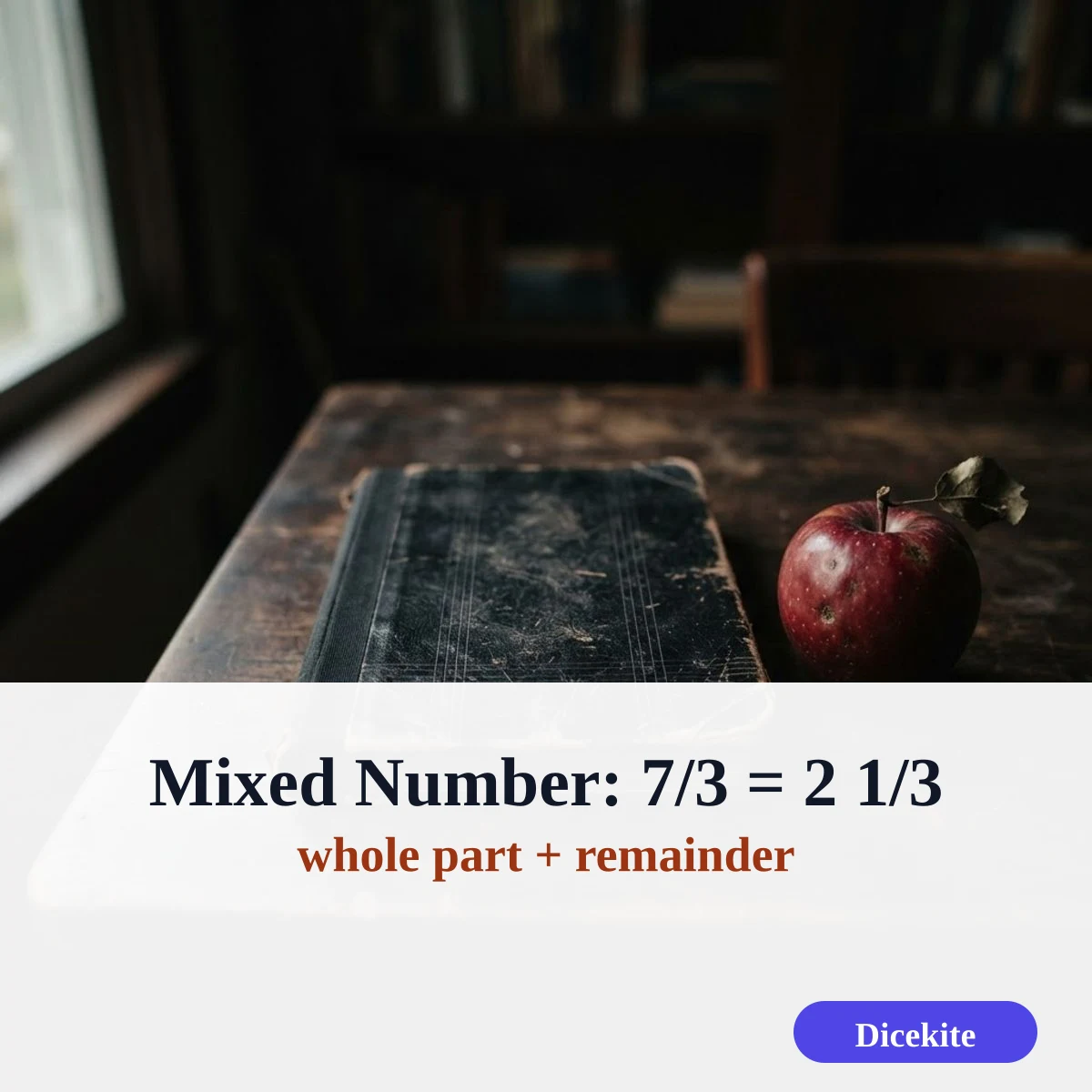
The second tool turns an improper fraction into a mixed number. Divide the numerator by the denominator: the quotient is the whole part and the remainder over the denominator is the fraction, reduced to lowest terms. For 7/3 the quotient is 2 and the remainder 1, so 7/3 = 2 1/3. For 12/4 the remainder is 0, so the answer is just 3.
Updated: 2026-11-09
Did this fly?
Tell us if the generator worked for you or what to tweak.
Thank you! Your note has taken off.